
Airflow, not horsepower
Horsepower describes the motor. What your tools need is a volume of air delivered at a working pressure, measured in cubic feet per minute (CFM). CFM is always rated at a specific pressure, so compare compressors by CFM at the same PSI1. Most air tools are built to run at around 90 PSI2.
Step 1: List the tools and their air use
Write down every air tool in the shop: impact wrenches, ratchets, grinders, sanders, blow guns, spray guns, tire inflation and any air-powered equipment, such as lifts with air locks or air-operated lube pumps. Each tool's spec label or manual lists its air consumption in CFM or SCFM at a stated pressure. Use those numbers rather than a generic chart, since consumption varies by model.
Step 2: Add up what runs at the same time
The key is simultaneous use. If three tools run at the same time, you size for all three, not one1. Think through the busiest hour of the day, bay by bay.
| Example | Calculation |
|---|---|
| Tools running together | Add each tool's CFM rating at 90 PSI |
| Margin | Multiply the total by 1.20 to 1.25 |
| Target | A compressor rated for at least that CFM at the pressure your tools need |
If your tools need different pressures, size for the highest one3.
Step 3: Add a margin
Once you have the total, add 20 to 25 percent to cover leaks, inefficiencies and future growth3. Leaks deserve the attention: U.S. Department of Energy guidance puts leak losses at as much as 20 to 30 percent of a compressor's output, and finding and repairing leaks can bring that under 10 percent4. Repairing leaks also reduces the need for new compressor capacity4.
Step 4: Match the duty cycle
Duty cycle is how much of the time a compressor can run without overheating or excess wear. Piston compressors are often rated for 50 to 75 percent duty and suit intermittent demand. Rotary screw compressors run up to 100 percent and suit continuous demand1.
- Short bursts through the day: a piston compressor, single or two-stage depending on pressure, is usually the fit.
- On and off all day: piston or rotary screw, depending on CFM and hours.
- Steady demand most of the day: typically a rotary screw.
A two-stage piston compressor reaches higher pressure, but its duty cycle is no higher than a single-stage unit's5.
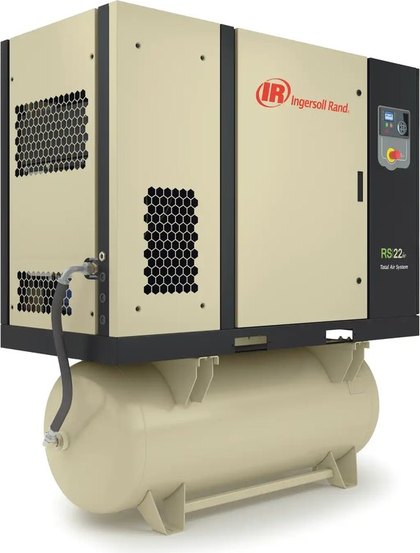
Piston and rotary screw compressors, dryers and filters, and Prevost aluminum piping, sized to your bays and installed by our crews. The sizing helper on our air compressor page gives you a starting point in two questions.
Use the sizing helperSize the rest of the system too
A well-sized compressor can still fall short if the rest of the system holds it back.
- Piping. Size the drying, filtration and distribution system so the total pressure drop from the compressor to the point of use stays below 10 percent of the compressor's discharge pressure4.
- Storage. A larger tank means less work for a piston compressor5, and it smooths out short bursts of demand.
- Air treatment. Compressed air carries moisture. A dryer and filters keep water and oil out of tools, lines and paint.
- Electrical. Confirm the voltage and phase available before choosing a model, since larger compressors often need three-phase power.
Turning up the pressure to make up for a weak line costs energy every hour the compressor runs. Fixing the leak or the undersized pipe usually costs less.
Signs a compressor is too small
- It runs almost constantly, or cycles on and off rapidly
- Tools lose power at the busiest times of day
- Pressure drops when several bays use air at once
- The compressor runs hot or trips on overload
Any of these is worth a look at both the compressor and the system around it, since leaks and undersized piping can mimic an undersized compressor.
Common questions
How much air does one service bay need?
It depends on the tools used in that bay and how many run at once. Add up the CFM ratings of the tools that run together, then add a margin. We size it bay by bay at the site visit.
Can a bigger tank make up for a small compressor?
A larger tank helps a piston compressor by reducing how hard it has to work through short bursts of demand, but it cannot supply more air than the compressor makes over time. If demand is steady, the compressor itself has to keep up.
Does a two-stage compressor have a higher duty cycle?
No. A two-stage piston compressor reaches higher pressure, but its duty cycle is not higher than a single-stage unit's.
When is a rotary screw compressor worth it?
When the shop uses air steadily through the day. Rotary screw compressors are built for continuous duty, while piston compressors are built for intermittent demand.
Do small air leaks really matter?
Yes. U.S. Department of Energy guidance puts leak losses as high as 20 to 30 percent of a compressor's output in poorly maintained systems, and finding and fixing leaks can bring that under 10 percent.
Sources
- Industrial Air Power, How to Choose an Industrial Air Compressor
- Anglian Compressors, What Size Air Compressor Do I Need?
- Pneutech, Industrial Air Compressor Sizing
- Bonneville Power Administration, Compressed Air System Energy Efficiency Measures (citing U.S. DOE)
- American Eagle, Air System FAQ
This guide is general information. Final sizing depends on your tools, building and electrical service, and on the compressor manufacturer's ratings.